8.17.1 Michelson modulation
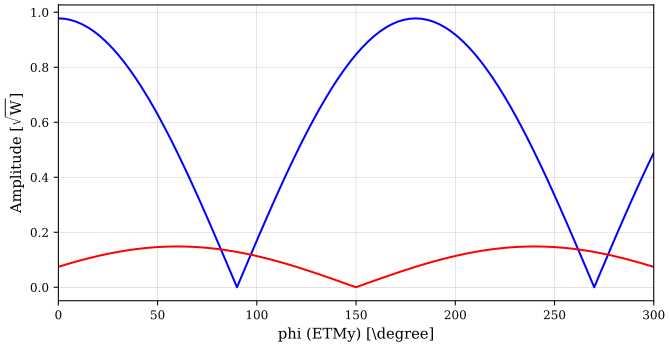
This example demonstrates how a macroscopic arm length difference can cause different ‘dark fringe’ tuning for injected fields with different frequencies. In this case, some of the 10 MHz modulation sidebands are transmitted when the interferometer is tuned to a dark fringe for the carrier light. This effect can be used to separate light fields of different frequencies. It is also the cause for transmission of laser noise (especially frequency noise) into the Michelson output port when the interferometer is not perfectly symmetric (Fig. 73).
import finesse
from finesse.analysis.actions import Xaxis
import numpy as np
import matplotlib.pyplot as plt
finesse.init_plotting()

base = finesse.Model()
base.parse(
    """
    l l1                            # laser with P=1W at the default frequency
    s s1 l1.p1 eom1.p1 L=1          # space of 1m length
    mod eom1 f=10M midx=0.3         # phase modulation at 10 MHz
    s s2 eom1.p2 bs1.p1 L=1         # another space of 1m length

    bs bs1 R=0.5 T=0.5              # 50:50 beam splitter
    s Ly bs1.p2 ETMy.p1 L=100       # north arm of 110m length
    m ETMy R=1 T=0                  # north end mirror, lossless
    s Lx bs1.p3 ETMx.p1 L=110       # east arm of 100m length
    m ETMx R=1 T=0                  # east end mirror, lossless

    ad carrier bs1.p4.o f=0         # amplitude detector for carrier field
    ad sideband bs1.p4.o f=10M      # amplitude detector for +10MHz sideband
    """
)

out = base.run(Xaxis(base.ETMy.phi, 'lin', 0, 300, 100))

plt.figure(figsize=(8, 4))
plt.plot(out.x1, np.abs(out['carrier']), label='carrier')
plt.plot(out.x1, np.abs(out['sideband']), label='sideband')
plt.xlabel(r'phi (ETMy) [\degree]')
plt.ylabel(r'Amplitude [$\sqrt{\mathrm{W}}$]')
plt.show()