Quantum-noise limited sensitivity of Advanced LIGO
This example shows how to compute the quantum-noise limited sensitivity of an interferometric gravitational wave detector with Finesse.
The optical configuration
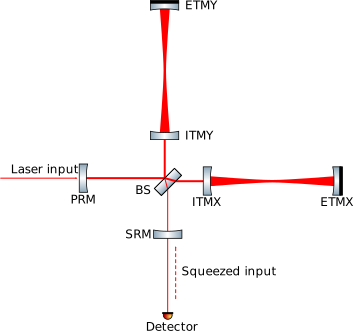
The optical layout is a very much simplified version of the Advanced LIGO interferometer, a Michelson interferometer with Fabry-Perot cavities in the arms, power recycling and signal recycling. Squeezed light is injected into the so-called dark port, which is also the main detection port, from which we measure the sensitivity.
The Finesse model
import finesse
finesse.configure(plotting=True)

kat = finesse.Model()
kat.parse(
    """
    ###########################################################################
    ###   Variables
    ###########################################################################
    var Larm 3995
    var Mtm  40
    var itmT 0.014
    var lmichx 4.5
    var lmichy 4.45

    ###########################################################################
    ###   Input optics
    ###########################################################################
    l L0 125
    s l_in L0.p1 prm.p1
    # Power recycling mirror
    m prm T=0.03 L=37.5u phi=90
    s prc prm.p2 bs.p1 L=53


    # Central beamsplitter
    bs bs T=0.5 L=0 alpha=45

    ###########################################################################
    ###   X arm
    ###########################################################################
    s lx bs.p3 itmx.p1 L=lmichx
    m itmx T=itmT L=37.5u phi=90
    s LX itmx.p2 etmx.p1 L=Larm
    m etmx T=5u L=37.5u phi=89.999875

    pendulum itmx_sus itmx.mech mass=Mtm fz=1 Qz=1M
    pendulum etmx_sus etmx.mech mass=Mtm fz=1 Qz=1M

    ###########################################################################
    ###   Y arm
    ###########################################################################
    s ly bs.p2 itmy.p1 L=lmichy
    m itmy T=itmT L=37.5u phi=0
    s LY itmy.p2 etmy.p1 L=Larm
    m etmy T=5u L=37.5u phi=0.000125

    pendulum itmy_sus itmy.mech mass=Mtm fz=1 Qz=1M
    pendulum etmy_sus etmy.mech mass=Mtm fz=1 Qz=1M

    ###########################################################################
    ###   Output and squeezing
    ###########################################################################
    s src bs.p4 srm.p1 L=50.525
    m srm T=0.2 L=37.5u phi=-90

    # A squeezed source could be injected into the dark port
    sq sq1 db=0 angle=90
    s lsqz sq1.p1 srm.p2

    # Differentially modulate the arm lengths
    fsig(1)
    sgen darmx LX.h
    sgen darmy LY.h phase=180

    # Output the full quantum noise limited sensitivity
    qnoised NSR_with_RP srm.p2.o nsr=True
    # Output just the shot noise limited sensitivity
    qshot NSR_without_RP srm.p2.o nsr=True

    # We could also display the quantum noise and the signal
    # separately by uncommenting these two lines.
    # qnoised noise srm.p2.o
    # pd1 signal srm.p2.o f=fsig
    """
)
<finesse.model.Model at 0x7ae32fcf1010>
The file sets up all the various optical cavities using a plane-wave model. The arm
cavity mirrors are suspended from a simple Pendulum with a resonance at 1 Hz. A
gravitational wave signal is injected as a modulation to both arm ‘spaces’, out of phase
by 180 degrees. We then use the qnoised and qshot
detectors to output the noise-to-signal ratio, or the sensitivity.
Output plots
out = kat.run("xaxis(darmx.f, log, 5, 5k, 100)")
out.plot(log=True, separate=False);
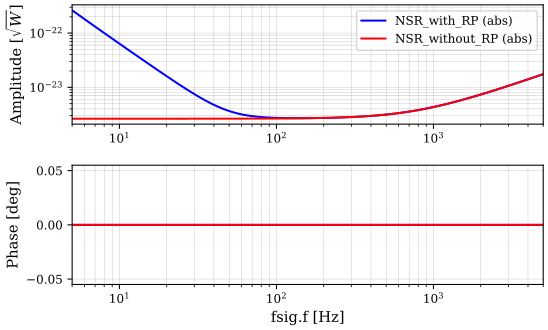
The model is loosely based on the Advanced LIGO design file, so we expect to see peak
sensitivity around 100 Hz at a sensitivity of about \(10^{-23}/\sqrt{\mathrm{Hz}}\).
We can see that both the qnoised and qshot agree at high
frequencies, because they both model shot noise correctly. At low frequencies we see
that they differ, as only qnoised takes into account the radiation pressure effects.