About Finesse

tocdepth:

2

About Finesse

What is Finesse

Finesse is a simulation program for interferometers. The user can build any kind of virtual laser interferometer using the following components:

  • lasers, with user-defined power, wavelength and shape of the output beam;

  • free spaces with arbitrary index of refraction;

  • mirrors and beam splitters, with flat or spherical surfaces;

  • modulators to change amplitude and phase of the laser light;

  • amplitude or power detectors with the possibility of demodulating the detected signal with one or more given demodulation frequencies;

  • lenses and isolators.

For a given optical setup, the program computes the light field amplitudes at every point in the interferometer assuming a steady state. To do so, the interferometer description is translated into a set of linear equations that are solved numerically. For convenience, a number of standard analyses can be performed automatically by the program, namely computing modulation-demodulation error signals and transfer functions. Finesse can perform the analysis using plane waves or Hermite-Gauss modes. The latter allows computation of the effects of mode matching and misalignments. In addition, error signals for automatic alignment systems can be simulated.
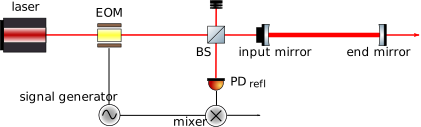
_images/pound_drever_hall01.svg

A schematic diagram of a laser interferometer which can be modelled using Finesse (in this case a Fabry-Perot cavity with a Pound-Drever-Hall control scheme).

Literally every parameter of the interferometer description can be tuned during the simulation. The typical output is a plot of a photodetector signal as a function of one or two parameters of the interferometer (e.g. arm length, mirror reflectivity, modulation frequency, mirror alignment). Optional text output provides information about the optical setup including, but not limited to, mode mismatch coefficients, eigenmodes of cavities and beam sizes.

Finesse provides a fast and versatile tool that has proven to be very useful during design and commissioning of interferometric gravitational wave detectors. However, the program has been designed to allow the analysis of arbitrary, user-defined optical setups. In addition, it is easy to install and easy to use. Therefore Finesse is very well suited to study basic optical properties, like, for example, the power enhancement in a resonating cavity or modulation-demodulation methods.

Motivation

The search for gravitational waves with interferometric detectors has led to a new type of laser interferometer: new topologies are formed combining known interferometer types. In addition, the search for gravitational waves requires optical systems with a very long baseline, large circulating power and an enormous stability. The properties of this new class of laser interferometers have been the subject of extensive research for several decades.

Finesse has been used to support the research on laser interferometers for gravitational wave detection since 1999 [1], and since 2013 Finesse is continuously developed as an open source project [2]. More about the background and the early years of Finesse (and Pykat) are available in the History section.

Finesse has become an important tool for the commissioning of Advanced LIGO [3], Advanced Virgo [4] and KAGRA [5] and is used for the design of future detectors such as the Einstein Telescope [6]. The Impact section lists more than 100 documents citing Finesse.

Finesse version 3 is a complete re-development, started in 2017, of both the original software, and its eventual wrapper and utility code Pykat [7, 8]. The main aim of the redevelopment was to transform our well tested and established tool with a large active user base into a modern software package and to make Finesse ready for the next 20 years of active research in laser interferometry.
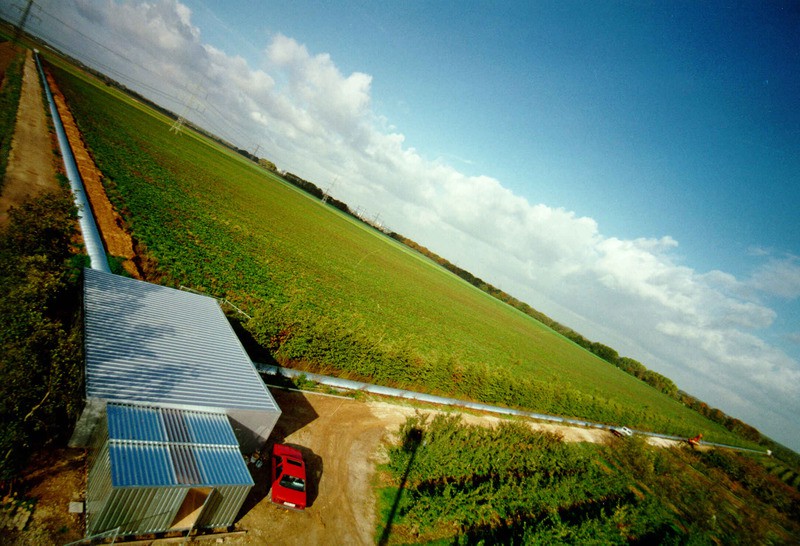
_images/geo600_birds_eye.jpg

Bird’s eye view of the GEO 600 gravitational wave detector near Hannover, Germany. Image courtesy of Harald Lück, Albert Einstein Institute Hannover.

Several prototype interferometers had been developed to investigate laser-interferometer technologies for detecting gravitational waves. This was followed by the work on the large-scale laser interferometric gravitational wave detectors that led to the first direct detection of a gravitational wave by the LIGO interferometers in 2015 [9]. Gravitational-wave astronomy is now an established field in science in which instrument science remains a major challenge.

The optical systems involved, Fabry-Perot cavities, a Michelson interferometer and combinations thereof are in principle simple and have been used in many fields of science for many decades. The sensitivity required for the detection of the expected small signal amplitudes of gravitational waves, however, has put new constraints on the design of laser interferometers. The work of the gravitational wave research groups has led to a new exploration of the theoretical analysis of laser interferometers. Especially, the clever combination of known interferometers has produced new types of interferometric detectors that offer an optimised sensitivity for detecting gravitational waves. We have shown that the models describing the optical system become very complex even though they are based on simple principles. Consequently, computer programs have been developed to automate the computational part of the analysis. To date, several custom-made programs for analysing optical systems are available to the gravitational wave community, and Finesse is one of the most widely used tools in this field.

Who is the Finesse Team

Finesse has been developed with the help of many people over more than 20 years. Thanks to everyone who has improved Finesse by contributing code, bug reports, documentation, training and support for students and input on the design, features, and the future development of the software.

In late 2017 Daniel Brown and Andreas Freise started Finesse 3, a re-implementation of Finesse in Python, with the idea to provide a modern and clean code base that makes further developing and extending the software simpler, especially for external contributors. The aim is to merge the established features and reliability of Finesse with a modular and hackable object based design, and to add some cool new features in the process!

This process continued with a growing number of key contributors and we expect to attract many more along the way:

Core Finesse development:

_images/andreas.jpg

Andreas Freise, University of Amsterdam and Nikhef: Project lead

_images/daniel.jpg

Daniel Brown, University of Adelaide: Project and programming lead

_images/miron.jpeg

Miron Van Der Kolk, Nikhef: Core developer. Development of polarisation features as well as maintenance and improvements to Finesse on all fronts.

_images/sam.jpg

Samuel Rowlinson, University of Birmingham: Developer with key contributions to the beam tracing, higher-order modes features, integration with Cython, the code structure and design, and the Sphinx documentation.

_images/philip.jpg

Philip Jones, University of Birmingham: Developer with key contributions to the quantum noise implementation, signal and noise features, the legacy parser, and the external Jupyter and Pygments extensions.

_images/sean.jpg

Sean Leavey, Albert-Einstein-Institute Hannover: Developer with key contributions to the new KatScript syntax, parser and command line interface, test suite, continuous integration tooling, the code structure and design, and the documentation.

Contributors to the Finesse development

Contributors to the Finesse 3 code are listed below. Other contributions to earlier versions are described in the History section.

  • Aaron Jones, University of Western Australia: developer with key contributions to the test suite, Finesse validation, documentation and continous integration. Primary developer of the BrumSoftTest validation tool, which was developed for Finesse validation.

  • Mischa Sallé, Nikhef

  • Jan Just Keijser, Nikhef

  • Duncan Macleod, Cardiff University: Conda packaging, Windows fixes

  • Alexei Ciobanu, University of Adelaide: faster map integration code

  • Lee McCuller

  • Huy Tuong Cao, University of Adelaide: testing of thermal effects and FEA comparisons

  • Paul Hapke, Albert-Einstein-Institute Hannover

  • Kevin Kuns, MIT, LIGO and Cosmic Explorer: Contributions on new tests, bug fixes, and harrassing project lead and programming lead for new features and user interface improvements.

Contributions to testing, documenting and training

  • Anna Green, University of Florida: LIGO training session, syntax reference and cheatsheet, Finesse workshops and …

  • Sean Leavey, AEI: Finesse workshop, Finesse manual, Ifosim logbook and …

  • Daniel Töyrä

  • Charlotte Bond: Finesse notes and papers

  • Daniel Brown and Andreas Freise: Original Finesse manual and related papers, Finesse workshops and …

That Finesse has remained as one of the main software packages in the field over many years is to a large extend due to the efforts put into providing users with support and training material, which is available via the main Finesse page http://www.gwoptics.org/finesse/.

Much of the physics behind the Finesse code has been compiled in the open access Living Reviews article Interferometer techniques for gravitational-wave detection. We have described many of the ideas that led to the current design of Finesse 3 in the the article Pykat: Python package for modelling precision optical interferometers.

We host a logbook sharing modelling work by the community https://logbooks.ifosim.org/. The logbook is powered by a WordPress plugin by Sean Leavey and is maintained by Mischa Salle. Logbooks are a common tool for recording progress in collaborative research projects, in particular for large hardware projects such as gravitational wave detectors. Logbooks record and preserve who did what when and thus over time create a searchable archive of expert knowledge.

We also used the logbook to support one of our Finesse workshops https://logbooks.ifosim.org/iucaa2019/. You can see more examples of our in-person teaching in workshops in our online tutorials on modelling laser interferometry http://www.gwoptics.org/learn/, composed by Daniel Töyrä.

History

Finesse beginnings (1997 - 2010)

Finesse has been originally developed by Andreas Freise during his PhD at GEO 600 (Frequency domain interferometer simulation with higher-order spatial modes). The idea for Finesse was first raised in 1997, when I (Andreas) was visiting the Max-Planck-Institute for Quantum Optics in Garching, to assist Gerhard Heinzel with his work on Dual Recycling at the 30 m prototype interferometer [10]. We were using optical simulations which were rather slow and not very flexible. At the same time Gerhard Heinzel had developed a linear circuit simulation ‘LISO’ that used a numerical algorithm to solve the set of linear equations representing an electronic circuit. The similarities of the two computational tasks and the outstanding performance of LISO lead to the idea to use the same methods for an optical simulation. Gerhard Heinzel kindly allowed me to copy the LISO source code which saved me much time and trouble in the beginning.

In the following years Finesse was continually developed at the University in Hannover within the GEO project [11, 12]. Finesse has been frequently utilised during the commissioning of GEO 600 [13, 14, 15].

Finesse 1 and 2 (2011 - to date)

At the University of Birmingham Andreas started a new research group with a focus on optical technology and interferometer design. Over the years many members of the research group contributed to or used Finesse for their research. In particular, PhD student Daniel Brown became lead programmer and improved the code overall while adding several new features. With his efforts Finesse reached version 1.0 and was made available as open source. Charlotte Bond became a specialist in modelling higher-order optical modes and ensured mirror surface maps or strange beam shapes implemented correctly in Finesse. Keiko Kokeyama, Paul Fulda, Ludovico Carbone and Anna Green have helped making Finesse a useful tool for the Advanced LIGO commissioning team. Mengyao Wang and Rebecca Palmer and Jan Harms helped Daniel with implementing radiation pressure effects and a full quantum noise treatment in the two-photon formalism.

Pykat (2014 - to date)

Modelling the complex gravitational wave detectors often involves an iterative sequence of many tasks. From the beginning we have used scripting languages to prepare, run and post-process Finesse simulations, for example using Octave and Matlab (http://www.gwoptics.org/simtools/). In 2014 we could see that Python would become one of the most common and powerful scripting tools in gravitational wave research. We therefore started to port our existing Matlab tools and scripts related to optical modelling to Python. In addition, Daniel Brown wrote a new comprehensive Python wrapper for running Finesse. These tools have been merged and then published as the open source package Pykat (https://www.gwoptics.org/pykat/) with contributions Philip Jones, Samuel Rowlinson, Sean Leavey, Anna C.Green and Daniel Töyrä.

Impact

Finesse has been widely used in several projects; most dominantly by the gravitational wave groups all over the world. This section provides an incomplete list of documents citing the Finesse software, to document the wide and sustained impact the software has on this research field.

_images/finesse_downloads2014.png

Accumulated unique downloads of the Finesse binary over an example period.

_images/finesse_globe2014.jpg

Locations of Finesse downloads (program and manual) for the same period as shown above.

If you are using Finesse for your work or research, we would like to know about it. We also appreciate if you acknowledge Finesse in publications that make use of Finesse results. See How to cite.

  1. Design, fabrication, and testing of an optical truss interferometer for the LISA telescope Jersey, Kylan and Zhang, Yanqi and Harley-Trochimczyk, Ian and Guzman, Felipe Astronomical Optics: Design, Manufacture, and Test of Space and Ground Systems III, 2021

  1. The Gravitational Wave Universe Toolbox: A software package to simulate observation of the Gravitational Wave Universe with different detectors Shu-Xu Yi, Gijs Nelemans, Christiaan Brinkerink, Zuzanna Kostrzewa-Rutkowska, Sjoerd T. Timmer, Fiorenzo Stoppa, Elena M. Rossi, Simon F. Portegies Zwart

  1. The analysis, experimental characterisation and prototyping of technologies for making quantum noise limited detections of gravitational waves Joseph Briggs, 2021 PhD Thesis

  1. Controlling and Calibrating Interferometric Gravitational Wave Detectors, Craig Cahillane, 2021 PhD Thesis

  1. Modeling circulating cavity fields using the discrete linear canonical transform, A.A. Ciobanu, D.D. Brown, P.J. Veitch, D.J. Ottaway (2021)

  1. Optimizing Gravitational-Wave Detector Design for Squeezed Light. J.W. Richardson, S. Pandey, E. Bytyqi, T. Edo and R.X. Adhikari (2021)

  1. Two-Carrier Scheme: Evading the 3 dB Quantum Penalty of Heterodyne Readout in Gravitational-Wave Detectors, T. Zhang, P. Jones, J. Smetana, H. Miao, D. Martynov, A. Freise, and S. W. Ballmer, Phys. Rev. Lett. 126, 221301 (2021)

  1. Point absorbers in Advanced LIGO, Aidan F. Brooks et al. (2021)

  1. An Experiment for Observing Quantum Gravity Phenomena using Twin Table-Top 3D Interferometers, S. M. Vermeulen, L. Aiello, A. Ejlli, W. L. Griffiths, A. L. James, K. L. Dooley, H. Grote (2021)

  1. Implications of the quantum noise target for the Einstein Telescope infrastructure design Jones, Philip and Zhang, Teng and Miao, Haixing and Freise, Andreas, PRD 2020

  1. Higher-order Hermite-Gauss modes as a robust flat beam in interferometric gravitational wave detectors, Tao, Liu and Green, Anna and Fulda, Paul, PRD, 2020

  1. Increased sensitivity of higher-order laser beams to mode mismatches, A. W. Jones and A. Freise, Opt. Lett. 45, 5876-5878 (2020)

  1. Polarization-sensitive transfer matrix modeling for displacement measuring interferometry, Angus Bridges, Andrew Yacoot, Thomas Kissinger, and Ralph P. Tatam Appl. Opt. 59, 7694-7704 (2020)

  1. Temperature Control for an Intra-Mirror Etalon in Interferometric Gravitational Wave Detector Fabry–Perot Cavities, J. Brooks, M. Mantovani, A. Allocca, J. C. Diaz, V. Dattilo, A. Masserot and P. Ruggi, Galaxies 2020, 8(4), 80 (2020)

  1. Angular response of a triangular optical cavity analyzed by a linear approximation method, Satoshi Tanioka, Gui-guo Ge, Keiko Kokeyama, Masayuki Nakano, Junegyu Park, Kiwamu Izumi (2020)

  1. Pykat: Python package for modelling precision optical interferometers, D.D. Brown, P. Jones, S. Rowlinson, S. Leavey, A. Green, D. Toyra and A.Freise (2020)

  1. Practical test mass and suspension configuration for a cryogenic kilohertz gravitational wave detector, J. Eichholz, N. A. Holland, V. B. Adya, J. V. van Heijningen, R. L. Ward, B. J. J. Slagmolen, D. E. McClelland, and D. J. Ottaway, Phys. Rev. D 102, 122003 (2020)

  1. Simplified optical configuration for a sloshing-speedmeter-enhanced gravitational wave detector, A. Freise, H. Miao, D.D. Brown (2019)

  1. Neutron Star Extreme Matter Observatory: A kilohertz-band gravitational-wave detector in the global network, K. Ackley et al., Publications of the Astronomical Society of Australia, 37, E047 (2020)

  1. Active sorting of orbital angular momentum states of light with a cascaded tunable resonator, Wei, S., Earl, S.K., Lin, J. et al. (2019)

  1. Influence of nonuniformity in sapphire substrates for a gravitational wave telescope, K. Somiya, E. Hirose, Y. Michimura, Physical Review D, Volume 100, Issue 8, id.082005 (2019)

  1. Multi-spatial-mode effects in squeezed-light-enhanced interferometric gravitational wave detectors, D. Töyrä et al., Phys. Rev. D 96, 022006 (2017)

  1. Alignment sensing for optical cavities using radio-frequency jitter modulation, P. Fulda et al., Applied Optics Vol. 56, Issue 13, pp. 3879-3888 (2017)

  1. The Holometer: an instrument to probe Planckian quantum geometry, Aaron Chou et al., Classical and Quantum Gravity, Volume 34, Number 6 (2017)

  1. Higher-order Laguerre–Gauss modes in (non-) planar four-mirror cavities for future gravitational wave detectors, A. Noack, C. Bogan, and B. Willke, Optics Letters Vol. 42, Issue 4, pp. 751-754 (2017)

  1. The influence of dual-recycling on parametric instabilities at Advanced LIGO, A.G. Green et al., Classical and Quantum Gravity, Volume 34, Number 20 (2017)

  1. Broadband sensitivity enhancement of detuned dual-recycled Michelson interferometers with EPR entanglement, D. D. Brown et al., Phys. Rev. D 96, 062003 (2017)

  1. Control of the gravitational wave interferometric detector Advanced Virgo, J. C. Diaz, PhD Thesis, Université Paris-Saclay (2017)

  1. Enhancing the sensitivity of future laser-interferometric gravitational wave detectors, S.S. Leavey, PhD Thesis, University of Glasgow (2017)

  1. Interactions of light and mirrors: advanced techniques for modelling future gravitational wave detectors, D. D. Brown, PhD Thesis, University of Birmingham (2016)

  1. Length Sensing and Control for AdLIGO , Kentaro Somiya, Osamu Miyakawa, Peter Fritschel, and Rana Adhikali (2016)

  1. Searching for photon-sector Lorentz violation using gravitational-wave detectors, V.A. Kostelecký, A.C. Melissinos, and M. Mewes, Physics Letters B, Volume 761, p. 1-7 (2016)

  1. Design study and prototype experiment of the KAGRA output mode-cleaner , K Kazushiro Yano, Ayaka Kumeta and Kentaro Somiya (2016)

  1. Length sensing and control for Einstein Telescope Low Frequency , V. Adya et al. (2016)

  1. Analytical calculation of Hermite-Gauss and Laguerre-Gauss modes on a bullseye photodiode, Charlotte Bond, Paul Fulda and Andreas Freise (2016)

  1. Alignment sensing and control for squeezed vacuum states of light , Emil Schreiber et al. (2015)

  1. Fast Simulation of Gaussian-Mode Scattering for Precision Interferometry , Daniel Brown, Rory Smith and Andreas Freise (2015)

  1. Local-Oscillator Noise Coupling in Balanced Homodyne Readout for Advanced Gravitational Wave Detectors , Sebastian Steinlechner et al. (2015)

  1. Upper limit to the transverse to longitudinal motion coupling of a waveguide mirror, S Leavey, B W Barr, A S Bell, N Gordon, C Gräf, S Hild, S H Huttner, E-B Kley, S Kroker, J Macarthur, Classical and Quantum Gravity Volume 32 Number 17 (2015)

  1. Active wavefront control in and beyond Advanced LIGO, A. F. Brooks, R. X. Adhikari, S. Ballmer, L. Barsotti, P. Fulda, A. Perreca, LIGO technical note, LIGO-T1500188 (2015)

  1. In-situ characterization of the thermal state of resonant optical interferometers via tracking of their higher-order mode resonances, Chris L. Mueller, Paul Fulda, Rana X. Adhikari, Koji Arai, Aidan F. Brooks, Rijuparna Chakraborty, Valery V. Frolov, Peter Fritschel, Eleanor J. King, David B. Tanner, Hiroaki Yamamoto, Guido Mueller, Classical and Quantum Gravity Volume 32 Number 13 (2015)

  1. Design study of the KAGRA output mode cleaner, Ayaka Kumeta, Charlotte Bond, Kentaro Somiya, Optical Review, Volume 22, Issue 1, pp 149-152 (2015)

  1. Advanced Virgo: a second generation interferometric gravitational wave detector, F. Acernese et al., Class. Quantum Grav. 32 024001 (2015)

  1. How to stay in shape: overcoming beam and mirror distortions in advanced gravitational wave interferometers Charlotte Zoë Bond, Ph.D. thesis, University of Birmingham (2014)

  1. Thermal correction of astigmatism in the gravitational wave observatory GEO 600 H. Wittel et al., Class. Quantum Grav. 31 065008 (2014)

  1. Sub nrad beam pointing monitoring and stabilization system for controlling input beam jitter in GW interferometers B. Canuel et al., Applied Optics, Vol. 53, Issue 13, pp. 2906-2916 (2014)

  1. Concepts and research for future detectors, F. Acernese et al., General Relativity and Gravitation (2014)

  1. Analytical description of interference between two misaligned and mismatched complete Gaussian beams, G. Wanner and G. Heinzel, Applied Optics, Vol. 53, Issue 14, pp. 3043-3048 (2014)

  1. Design of a speed meter interferometer proof-of-principle experiment, C. Gräf et al., Class. Quantum Grav. 31 215009 (2014)

  1. Design study of the KAGRA output mode-cleaner, Ayaka Kumeta, Charlotte Bond, Kentaro Somiya (2014)

  1. Accelerated convergence method for fast Fourier transform simulation of coupled cavities, R. A. Day et al., Journal of the Optical Society of America A 31 652 (2014)

  1. Full modal simulation of opto-mechanical effects in optical systems, Gabriele Vajente, Classical and Quantum Gravity 31 075005 (2014)

  1. Comparing simulations of the Advanced LIGO Dual-Recycled Michelson C. Bond, P. Fulda, D. Brown and A. Freise, LIGO DCC: T1400270 (2014)

  1. Finesse input files for the L1 interferometer, C. Bond, P. Fulda, D. Brown, K. Kokeyama, L. Carbone and A. Freise, LIGO DCC: T1300901 (2014)

  1. Finesse input files for the H1 interferometer, C. Bond, P. Fulda, D. Brown, K. Kokeyama, L. Carbone, A.Perreca and A.Freise, LIGO DCC: T1300904 (2014)

  1. Simulations of effects of LLO mode-mismatches on PRFPMI error signals, C. Bond, P. Fulda, D. Brown and A. Freise, LIGO DCC: T1400182 (2014)

  1. Comparing Finesse simulations, analytical solutions and OSCAR simulations of Fabry-Perot alignment signals, S. Ballmer, J. Degallaix, A. Freise and P. Fulda, LIGO DCC: T1300345 and arXiv preprint arXiv:1401.5727, (2014)

  1. Optical Design and Numerical Modeling of the AEI 10m Prototype sub-SQL Interferometer, Christian Graef, PhD Thesis, University of Hannover (2013)

  1. Revisiting Sidebands of Sidebands in Finesse, J. Clarke, H. Wang, D. Brown and A. Freise, LIGO DCC: T1300986 (2013)

  1. Interferometer responses to gravitational waves: Comparing FINESSE simulations and analytical solutions, C, Bond, D. Brown, A. Freise (2013)

  1. Investigation of beam clipping in the Power Recycling Cavity of Advanced LIGO using FINESSE C. Bond, P. Fulda, D. Brown and A. Freise, LIGO DCC: T1300954 (2013)

  1. Finesse simulation for the alignment control signal of the aLIGO input mode cleaner, K. Kokeyama, K. Arai, P. Fulda, S. Doravari, L. Carbone, D. Brown. C. Bond and A. Freise, LIGO DCC: T1300074 (2013)

  1. Report from the Commissioning Workshop at LLO, K. Dooley et al., LIGO DCC: T1300497 (2013)

  1. Interferometer responses to gravitational waves: Comparing Finesse simulations and analytical solutions, C. Bond, D. Brown and A. Freise, LIGO DCC: T1300190 and arXiv preprint arXiv:1306.6752 (2013)

  1. Phase effects due to beam misalignment on diffraction gratings Deepali Lodhia, Daniel Brown, Frank Brueckner, Ludovico Carbone, Paul Fulda, Keiko Kokeyama, Andreas Freise (2013)

  1. A realistic polarizing Sagnac topology with DC readout for the Einstein Telescope Mengyao Wang, Charlotte Bond, Daniel Brown, Frank Brueckner, Ludovico Carbone, Rebecca Palmer, Andreas Freise, Phys. Rev. D 87, 096008 (2013)

  1. Generation of high-purity higher-order Laguerre-Gauss beams at high laser power L. Carbone, C. Bogan, P. Fulda, A. Freise, B. Willke, Phys. Rev. Lett., 110, 25 (2013)

  1. Length sensing and control of a Michelson interferometer with power recycling and twin signal recycling cavities Christian Graef et al, Optics Express, 21, 5287 (2013)

  1. Fast modal simulation of paraxial optical systems: the MIST open source toolbox G. Vajente, Class. Quantum Grav. 30 075014 (2013)

  1. Experimental test of higher-order Laguerre–Gauss modes in the 10 m Glasgow prototype interferometer B Sorazu, P J Fulda, B W Barr, A S Bell, C Bond, L Carbone, A Freise, S Hild, S H Huttner, J Macarthur and K A Strain, Class. Quantum Grav. 30 035004 (2013)

  1. Precision Interferometry in a New Shape: Higher-order Laguerre-Gauss Modes for Gravitational Wave Detection Paul Fulda, Ph.D. thesis, University of Birmingham (2012)

  1. Status of the GEO 600 squeezed-light laser Khalaidovski, Alexander; Vahlbruch, Henning; Lastzka, Nico; Graef, Christian; Lueck, Harald; Danzmann, Karsten; Grote, Hartmut; Schnabel, Roman, Journal of Physics: Conference Series, Volume 363, Issue 1, pp. 012013 (2012)

  1. Advanced Virgo Technical Design Report Accadia et al. (The Virgo Collaboration), Virgo technical note VIR–0128A–12 (2012)

  1. Phase effects in Gaussian beams on diffraction gratings D Lodhia, F Brueckner, L Carbone, P Fulda, K Kokeyama, A Freise, Journal of Physics: Conference Series, Vol 363, number 1, pp 012014 (2012)

  1. The effect of mirror surface distortions on higher order Laguerre-Gauss modes C Bond, P Fulda, L Carbone, K Kokeyama, A Freise, Journal of Physics: Conference Series, Vol 363, number 1, 012005 (2012)

  1. Review of the Laguerre-Gauss mode technology research program at Birmingham Fulda, P.; Bond, C.; Brown, D.; Brückner, F.; Carbone, L.; Chelkowski, S.; Hild, S.; Kokeyama, K.; Wang, M.; Freise, A., Journal of Physics: Conference Series, Volume 363, Issue 1, pp. 012010 (2012)

  1. The output mode cleaner of GEO 600 Prijatelj, M.; Degallaix, J.; Grote, H.; Leong, J.; Affeldt, C.; Hild, S.; Lück, H.; Slutsky, J.; Wittel, H.; Strain, K.; Danzmann, K., Classical and Quantum Gravity, Volume 29, Issue 5, pp. 055009 (2012)

  1. Einstein gravitational wave Telescope conceptual design study M Abernathy et al (ET Science Team), ET technical note ET-0106C-10 (2011)

  1. Eigenmode changes in a misaligned triangular optical cavity F Kawazoe, R Schilling, H Lueck, Journal of Optics, Vol 13 055504 (2011)

  1. Diffractive gratings in high-precision interferometry for gravitational wave detection Jonathan Hallam, Ph.D. thesis, University of Birmingham (2011)

  1. Higher order Laguerre-Gauss mode degeneracy in realistic, high finesse cavities C Bond, P Fulda, L Carbone, K Kokeyama, A Freise, Physical Review D, Vol 84, number 10, id 102002 (2011)

  1. Optical properties of 3-port-grating coupled cavities Oliver Burmeister, Ph. D. thesis, university of Hannover (2010)

  1. Experimental demonstration of higher-order Laguerre-Gauss mode interferometry Fulda, Paul; Kokeyama, Keiko; Chelkowski, Simon; Freise, Andreas, Physical Review D, vol. 82, Issue 1, id. 012002 (2010)

  1. Experimental demonstration of displacement noise free interferometry Antonio Perreca, Ph. D. Thesis, University of Birmingham (2010)

  1. Gravitational-wave detector-derived error signals for the LIGO thermal compensation system R S Amin, J A Giaime, Classical and Quantum Gravity, Vol 27, pp 215002 (2010)

  1. Automatic Alignment for the first science run of the Virgo interferometer F Acernese et al., Astroparticle Physics, Vol 33, number 3, pp 131 (2010)

  1. Interferometer Techniques for Gravitational-Wave Detection A.Freise and K.Strain, Living Reviews in Relativity, 13 (2010)

  1. Modeling Thermal Phenomena and Searching for New Thermally Induced Monitor Signals in Large Scale Gravitational Wave Detectors R Amin, Ph. D. thesis, University of Florida (2010)

  1. Broadband squeezing of quantum noise in a Michelson interferometer with Twin-Signal-Recycling A Thuering, C Graef, H Vahlbruch, M Mehmet, K Danzmann, R Schnabel, Optics letters, Vol 34, number 6, pp 824 (2009)

  1. Virgo Input Mirrors thermal effects characterization, R. Day, V. Fafone, J. Marque, M. Pichot, M. Punturo, A. Rocchi, Virgo technical note VIR-0191A-10 (2010)

  1. DC-readout of a signal-recycled gravitational wave detector S Hild, H Grote, J Degallaix, S Chelkowski, K Danzmann, A Freise, M Hewitson, J Hough, H Lueck, M Prijatelj, K A Strain, J R Smith, B Willke, Classical and Quantum Gravity, Vol 26, 055012 (2009)

  1. Prospects of higher-order Laguerre-Gauss modes in future gravitational wave detectors S Chelkowski, S Hild, A Freise, Physical Review D, Vol 79, issue 12, id 122002 (2009)

  1. Using the etalon effect for in situ balancing of the Advanced Virgo arm Cavities Hild, S.; Freise, A.; Mantovani, M.; Chelkowski, S.; Degallaix, J.; Schilling, R., Classical and Quantum Gravity, Volume 26, Issue 2, pp. 025005 (2009)

  1. On Special Optical Modes and Thermal Issues in Advanced Gravitational Wave Interferometric Detectors Jean-Yves Vinet, Living Rev. Relativity 12, (2009)

  1. Coupling of lateral grating displacement to the output ports of a diffractive Fabry-Perot cavity J Hallam, S Chelkowski, A Freise, S Hild, B Barr, K A Strain, O Burmeister, R Schnabel, Journal of Optics A: Pure and Applied Optics, Volume 11, Issue 8, pp. 085502 (2009)

  1. Quantum noise and radiation pressure effects in high power optical interferometers T R Corbitt, Ph. D. Thesis, Massachusetts Institute of Technology (2008)

  1. Measurement and simulation of laser power noise in GEO 600 J R Smith, J Degallaix, A Freise, H Grote, M Hewitson, S Hild, H Lueck, K A Strain, B Willke, Classical and Quantum Gravity, Vol 25, pp 035003 (2008)

  1. Development of a signal-extraction scheme for resonant sideband extraction K.Kokeyama, K.Somiya, F.Kawazoe, S.Sato, S.Kawamura, and A.Sugamoto, Classical Quantum Gravity, Vol 25, pp 235013 (2008)

  1. Experimental investigation of a control scheme for a zero-detuning resonant sideband extraction interferometer for next-generation gravitational-wave detectors F.Kawazoe, A.Sugamoto, V.Leonhardt, S.Sato, T.Yamazaki, M.Fukushima, S. Kawamura, O.Miyakawa, K.Somiya, T.Morioka, and A.Nishizawa, Classical Quantum Gravity, Vol 25, pp 195008 (2008)

  1. Demonstration of Displacement- and Frequency-Noise-Free Laser Interferometry Using Bidirectional Mach-Zehnder Interferometers S.Sato, K.Kokeyama, R.L.Ward, S.Kawamura, Y.Chen, A.Pai, and K.Somiya, Physics Review Letters, Vol 98, id 141101 (2007)

  1. Beyond the first Generation: Extending the Science Range of the Gravitational Wave Detector GEO 600. Stefan Hild, Ph. D. thesis, University of Hannover (2007)

  1. Squeezed Light and Laser Interferometric Gravitational Wave Detectors Simon Chelkowski, Ph. D. thesis, University of Hannover (2007)

  1. The GEO 600 core optics W Winkler et al., Optics Communications, Vol 280, number 2, pp 492 (2007)

  1. Measurement of the optical parameters of the Virgo interferometer F Acernese et al., Applied Optics, Vol 46, pp 3466 (2007)

  1. Demonstration and comparison of tuned and detuned signal recycling in a large-scale gravitational wave detector S Hild, H Grote, M Hewitson, H Lueck, J R Smith, K A Strain, B Willke, K Danzmann, Classical and Quantum Gravity, Vol 24, pp 1513 (2007)

  1. A novel concept for increasing the peak sensitivity of LIGO by detuning the arm cavities S Hild, A Freise, Classical and Quantum Gravity, Vol 24, pp 5453 (2007)

  1. Optical modulation techniques for length sensing and control of optical cavities B W Barr, S H Huttner, J R Taylor, B Sorazu, M Plissi, K A Strain, Applied optics, Vol 46, number 31, pp 7739 (2007)

  1. The Virgo automatic alignment system F Acernese et al., Classical and Quantum Gravity, Vol 23, pp 91 (2006)

  1. Measurement of a low-absorption sample of OH-reduced fused silica S Hild, H Lueck, W Winkler, K A Strain, H Grote, J Smith, M and Malec, M Hewitson, B Willke, J Hough, K Danzmann, Applied optics, Vol 45, number 28, pp. 7269 (2006)

  1. Des tests du Modele Standard a la recherche d’ondes gravitationnelles E Tournefier, habilitation (2006)

  1. Lock Acquisition Scheme for the Advanced LIGO Optical Configuration O Miyakawa et al., Journal of Physics: Conference Series, 32 265–269 (206)

  1. Control sideband generation for dual-recycled laser interferometric gravitational wave detectors B W Barr, O Miyakawa, S Kawamura, A J Weinstein, R Ward, S Vass, K A Strain, Classical and Quantum Gravity, Vol 23, pp 5661 (2006)

  1. Compensation of strong thermal lensing in advanced interferometric gravitational waves detectors J. Degallaix, Ph. D. Thesis University of Western Australia (2006)

  1. ` <http://deposit.ddb.de/cgi-bin/dokserv?idn=982491557&dok_var=d1&dok_ext=pdf&filename=982491557.pdf%0A>`__ Formulation of instrument noise analysis techniques and their use in the commissioning of the gravitational wave observatory, GEO 600 JR Smith Ph. D. thesis, University of Hannover (2006)

  1. Diagonalizing sensing matrix of broadband RSE S.Sato, K.Kokeyama, F.Kawazoe, K.Somiya, and S.Kawamura, Journal of Physics Conference Series, Vol 32, pp 470 (2006)

  1. Downselect of the signal extraction scheme for LCGT K.Kokeyama, S.Sato, F.Kawazoe, K.Somiya, M.Fukushima, S.Kawamura, and A. Sugamoto, Journal of Physics Conference Series, Vol 32, pp 424 (2006)

  1. Commissioning of advanced, dual-recycled gravitational-wave detectors: simulations of complex optical systems guided by the phasor picture M Malec, Ph. D. thesis, University of Hannover (2006)

  1. Mathematical framework for simulation of quantum fields in complex interferometers using the two-photon formalism T Corbitt, Y Chen, N Mavalvala, Physical Review A, vol. 72, Issue 1, id. 013818 (2005)

  1. Development of a frequency-detuned interferometer as a prototype experiment for next-generation gravitational-wave detectors K.Somiya, P.Beyersdorf, K.Arai, S.Sato, S.Kawamura, O.Miyakawa, F. Kawazoe, S.Sakata, A.Sekido, and N.Mio, Applied Optics, Vol 44, pp 3179 (2005)

  1. Feedforward correction of mirror misalignment fluctuations for the GEO 600 gravitational wave detector J R Smith, H Grote, M Hewitson, S Hild, H Lueck, M Parsons, K A Strain, B Willke, Classical and Quantum Gravity, Vol 22, pp 3093 (2005)

  1. The status of GEO 600 H Grote et al., Classical and Quantum Gravity, Vol 22, pp. 193 (2005)

  1. Towards dual recycling with the aid of time and frequency domain simulations M Malec, H Grote, A Freise, G Heinzel, K A Strain, J Hough, K Danzmann, Classical and Quantum Gravity, Vol 21, pp 991 (2004)

  1. The status of GEO 600 Strain, K.A. et al. In: Proceeding of SPIE: Gravitational Wave and Particle Astrophysics Detectors (2004)

  1. Dual recycling for GEO 600 H Grote, A Freise, M Malec, G Heinzel, B Willke, H Lueck, K A Strain, J Hough, K Danzmann, Classical and Quantum Gravity, Volume 21, pp 473 (2004)

  1. Characterization of the LIGO 4 km Fabry–Perot cavities via their high-frequency dynamic responses to length and laser frequency variations M Rakhmanov, F Bondu, O Debieu, R L Savage Jr, Classical and Quantum Gravity, Vol 21, pp 487 (2004)

  1. Thermal lensing compensation for AIGO high optical power test facility J Degallaix, C Zhao, L Ju, D Blair, Classical and Quantum Gravity, Vol 21, pp 903 (2004)

  1. Thermal correction of the radii of curvature of mirrors for GEO 600 Lueck, H. Freise, A. Gossler, S. Hild, S. Kawabe, K. Danzmann, K., Classical and Quantum Gravity, Vol 21, pp 985 (2004)

  1. The Next Generation of Interferometry: Multi-Frequency Optical Modelling, Control Concepts and Implementation Andreas Freise, Ph. D. thesis, University of Hannover (2003)

  1. Positions-und Orientierungsregelung von als Pendel aufgehaengten Resonatorspiegeln U Weiland, Diploma Thesis, University of Hannover (2000)

How to cite

Finesse can be cited in publications, technical notes, or any other work by referencing the project-level Zenodo DOI https://doi.org/10.5281/zenodo.821363. This link will always take you to the latest version of the DOI. Version-specific ones can also be found on Zenodo.

BibTeX

For those using BibTeX to manage their references, the following BibTeX entry can be used to cite the project:

@software{brown_2025_12662017,
  author       = {Brown, Daniel David and
                  Freise, Andreas and
                  Cao, Huy Tuong and
                  Ciobanu, Alexei and
                  Gobeil, Jeremie and
                  Green, Anna and
                  Hapke, Paul and
                  Jones, Philip and
                  van der Kolk, Miron and
                  Kuns, Kevin and
                  Leavey, Sean and
                  Perry, Jonathan Warren and
                  Rowlinson, Samuel and
                  Sallé, Mischa},
  title        = {FINESSE},
  month        = mar,
  year         = 2025,
  publisher    = {Gitlab},
  version      = {3.0a32},
  doi          = {10.5281/zenodo.12662017},
  url          = {https://doi.org/10.5281/zenodo.12662017},
}

Download file: finesse_zenodo.bib

Acknowledgements

In the early days of the Finesse development, when the software was not much more than an idea, many people in the gravitational wave community have helped with feedback, bug reports and encouragement. Some of them are Seiji Kawamura, Guido Müller, Simon Chelkowski, Keita Kawabe, Osamu Miyakawa, Gabriele Vajente, Maddalena Mantovani, Alexander Bunkowski, Rainer Künnemeyer, Uta Weiland, Michaela Malec, Oliver Jennrich, James Mason, Julien Marque, Mirko Prijatelj, Jan Harms, Oliver Bock, Kentaro Somiya, Antonio Chiummo, Holger Wittel, Hartmut Grote, Bryan Barr, Sabina Huttner, Haixing Miao, Benjamin Jacobs, Stefan Ballmer, Nicolas Smith-Lefebvre, Daniel Shaddock and probably many more not mentioned here.

Gerhard Heinzel greatly supported the original development; he had the idea of using the LISO routines on interferometer problems and he provided his code for that purpose. Roland Schilling spent hours with Andreas on the phone discussing C and Fortran, or interferometers and optics. Ken Strain has been a constant source of help and support during the initial years of development. Jerome Degallaix has often helped with suggestions, examples and test results based on his code OSCAR to further develop and test Finesse. Paul Cochrane has made a big difference with his help on transforming the source code from its messy original form into a more professional package, including a test-suite, an API documentation and above all a readable source code.

Last but not least we would like to thank the GEO 600 group, especially Karsten Danzmann and Benno Willke, who allowed Andreas to work on Finesse in parallel to his experimental work on the GEO site. Finesse would not exist without their positive and open attitude towards science.