Radiation pressure
This example shows a simple example for a Finesse simulation of radiation pressure causing a mirror to move.
The optical configuration
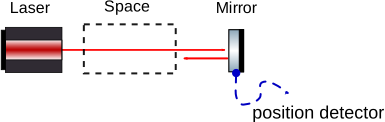
The optical layout is very simple, with a laser beam being reflected by a single mirror.
The interesting aspects of this setup are hidden in the details: The laser beam includes
an amplitude modulation ‘signal’ whose frequency we
can tune; secondly, the mirror is suspended on a Pendulum.
The position detector in the figure is for illustrative purposes only. This example uses
the freqresp action to directly calculate the transfer function between
the laser amplitude node l1.amp.i and the position node m1.mech.z.
See for example Modelling transfer functions and Calculating general transfer functions for discussions on how transfer functions are used in Finesse.
The Finesse model
import numpy as np

import finesse
from finesse.analysis.actions import FrequencyResponse
from finesse.plotting import bode

finesse.init_plotting()

model = finesse.Model()
model.parse(
    """
    # Optical setup: laser, space and mirror:
    l l1 P=1
    s s1 l1.p1 m1.p1
    m m1 R=1 T=0

    # Define a pendulum for our mirror, with a z-motion resonance at 10Hz
    # and Q factor of 1000
    pendulum sus1 m1.mech mass=1 fz=10 Qz=1000

    # Set a signal frequency to activate the signal simulation
    # (needed for radiation pressure effects to be observed)
    fsig(1)
    """
);
Note here that we use the fsig to activate a signal simulation. See
Signals for more information.
Output plots
sol = model.run(FrequencyResponse(np.geomspace(1, 100, 400), "l1.amp", "m1.mech.z"))
bode(sol.f, sol["m1.mech.z", "l1.amp"], db=False, label="m1.mech.z");
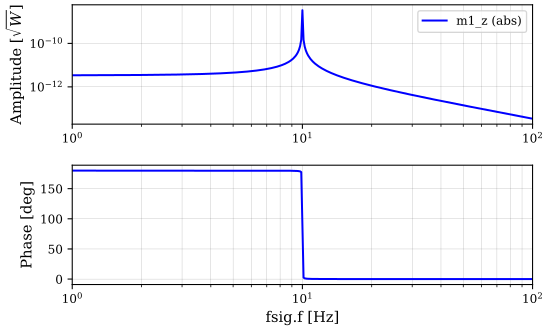
Upon reflection by the mirror the photons reverse their momentum. This momentum transfer
gives rise to a force on the mirror, the so-called ‘radiation-pressure force’. Finesse
assumes a steady state of the optical system, which in this case means that we assume
the static radiation-pressure force to be compensated by another static force, for
example via active control or through gravity. The amplitude modulation signal on the
laser light, however, creates a modulation of the force which we can model and measure
in a steady state. The mechanical transfer function of the mirror determines how the
longitudinal force (as a function of frequency) translates into motion. The
freqresp calculates this transfer function, showing a single pole at 10
Hz with a Q factor of 1000.
See also
For further reading, [26] gives a brief but fairly detailed introduction to radiation pressure effects in the context of gravitational wave detectors.