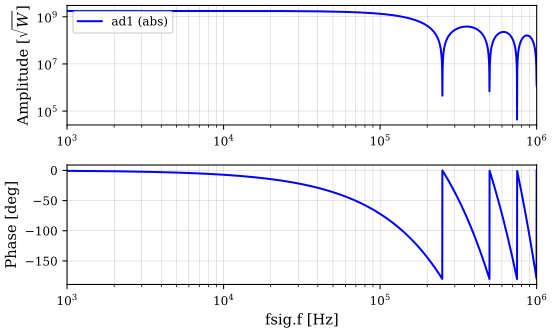
5.6.3 Michelson gravitational wave response
This is a simple Finesse example showing how the arm spaces can be modulated to produce the effect a gravitational wave would have on it. It outputs the amplitude and phase of the upper sideband that reaches the output port. The dips in amplitude occur when the travel time of the photons along the interferometer arms equals one gravitational wave period and hence the signal accumulated in the first and second half of the travel time cancel each other (the plot above does not have enough resolution to show that the dips indicate zero signal, the non-zero amplitudes are an artefact of the numerical plotting routine). In this example the frequencies of the dips are given as \(f= N\cdot c/1200 \text{m} = N\cdot250 \text{kHz}\), with \(N\) a positive integer (Fig. 36, generated here).
import finesse
from finesse.analysis.actions import Xaxis
finesse.init_plotting()

base = finesse.Model()
base.parse(
    """
    l l1 P=1                        # laser with P=1W at the default frequency
    s s1 l1.p1 bs1.p1 L=1           # space of 1m length
    bs bs1 R=0.5 T=0.5              # 50:50 beam splitter

    # The x-arm
    m ETMx T=100e-6 L=0             # east end mirror, lossless
    s Lx bs1.p3 ETMx.p1 L=600       # east arm of 600m length

    # The y-arm
    m ETMy T=100e-6 L=0 phi=90      # north end mirror, lossless
    s Ly bs1.p2 ETMy.p1 L=600       # north arm of 600m length

    # apply signal to each arm, 180 degrees out of phase
    fsig(1)
    sgen sig1 Lx.h
    sgen sig2 Ly.h phase=180

    ad ad1 bs1.p4.o fsig.f          # amplitude detector in south port
    """
)

out = base.run(Xaxis(base.fsig.f, 'log', 1e3, 1e6, 4000))
out.plot(log=True);