3.8.1 Modulation index
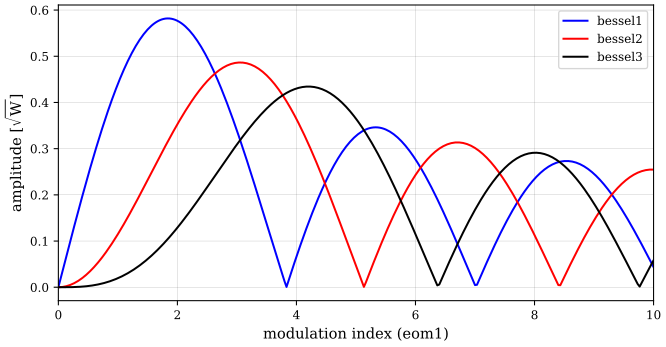
This file demonstrates the use of a modulator. Phase modulation with up to five higher harmonics is applied to a laser beam and amplitude detectors are used to measure the field at the first three harmonics. Compare this to Fig. 18 as well (Fig. 22, generated here).
import finesse
from finesse.analysis.actions import Xaxis
import numpy as np
import matplotlib.pyplot as plt
finesse.init_plotting()

base = finesse.Model()
base.parse(
    """
    l l1 P=1            # laser with P=1W at default frequency
    s s1 l1.p1 eom1.p1  # space of zero length to connect laser and modulator

    # Phase modulator at 40kHz, with a modulation index of 0.05
    mod eom1 f=40k midx=.05 order=5 mod_type=pm

    # Three amplitude detectors, looking at the first three positive modulation
    # sidebands
    ad bessel1 eom1.p2.o f=40k
    ad bessel2 eom1.p2.o f=80k
    ad bessel3 eom1.p2.o f=120k
    """
)

out = base.run(Xaxis(base.eom1.midx, 'lin', 0, 10, 300))

plt.figure(figsize=(8, 4))
plt.plot(out.x1, np.abs(out['bessel1']), label='bessel1')
plt.plot(out.x1, np.abs(out['bessel2']), label='bessel2')
plt.plot(out.x1, np.abs(out['bessel3']), label='bessel3')
plt.xlabel('modulation index (eom1)')
plt.ylabel(r'amplitude [$\sqrt{\mathrm{W}}$]')
plt.legend()
plt.show()