10.9.4 Impact of thermal aberrations
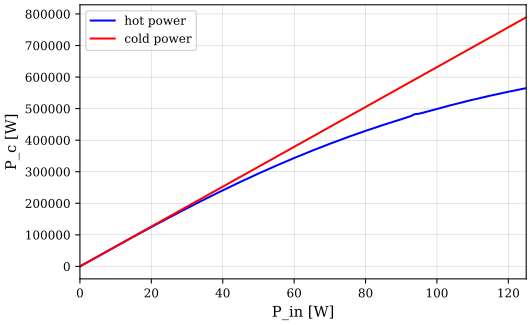
This example shows the power circulating in an Advanced LIGO style arm cavity versus input laser power when we consider the impact of thermal effects (lensing of the input mirror and change in curvature of the mirror surfaces). The mode mismatches these aberrations cause results in less power coupled into the cavity (Fig. 115, generated here).
We assume here that the thermal aberrations scale linearly with power (Vinet 2009). As we tune the incident laser power we also tune the thermal changes in curvature (\(\mathrm{d}R_{c,\mathrm{ITM}}\) and \(\mathrm{d}R_{c,\mathrm{ETM}}\)). Here we use the change in \(R_c\) calculated for an Advanced LIGO cavity operating at high power (125 W) and then scale the \(R_c\)’s accordingly. The curvatures are combined with the cold state curvatures to give the final state of the cavity mirrors at a given laser power. Similarly for the thermal lens in the ITM we scale the focal length, calculated for high power, with input power.
Finally we scale the power circulating in an individual arm cavity (\(P_c\)) by the gain afforded by the power recycling cavity (45 W/W) and the beam splitter (0.5) to represent the power in an arm of the full power recycled Michelson configuration.
We also plot the theoretical linear circulating power, when thermal effects are not considered. Here the 280.7 W is the circulating power in a cavity simulated with no thermal or higher order mode defects.
import matplotlib.pyplot as plt
import numpy as np

import finesse
from finesse.analysis.actions import Xaxis

finesse.init_plotting()

base = finesse.Model()
base.parse(
    """
    l l1                                    # laser with P=1W at the default frequency
    gauss g1 l1.p1.o w0=12m z=-1.83522k     # set up gaussian beam
    modes(maxtem=6)                         # include modes up to n+m=6

    var Pin 0                               # variable for input power
    var dRcITM -1/(1/55000*Pin/125+1e-20)
    var RcITM -1/(1/1934+1/dRcITM)          # Rc of input mirror
    var dRcETM -1/(1/80000*Pin/125+1e-20)
    var RcETM 1/(1/2245+1/dRcETM)           # Rc of end mirror

    s s1 l1.p1 lens1.p1 L=1             # a space of 1m length
    lens lens1 f=6700*125/(Pin+1e-20)   # thermal lens
    s s2 lens1.p2 ITM.p1                # space of zero length connecting lens to mirror
    m ITM T=0.014 L=35u Rc=RcITM        # cavity input mirror
    s scav ITM.p2 ETM.p1 L=3994.5       # cavity length of 3994.5m
    m ETM T=5u L=35u Rc=RcETM           # cavity end mirror
    cav cav1 ITM.p2                     # computing cavity parameters

    pd pd1 ETM.p1.i                     # photodiode measuring circulating power
    """
)

out = base.run(Xaxis(base.Pin, "lin", 0, 125, 500))


def hot_power(x, P_c):
    return P_c * x * 45 / 2


def cold_power(x):
    return x * 280.7 * 45 / 2


plt.figure()
plt.plot(out.x1, hot_power(np.abs(out.x1), out["pd1"]), label="hot power")
plt.plot(out.x1, cold_power(np.abs(out.x1)), label="cold power")
plt.xlabel("P_in [W]")
plt.ylabel("P_c [W]")
plt.legend()
plt.show()