9.17.3 LG33 mode
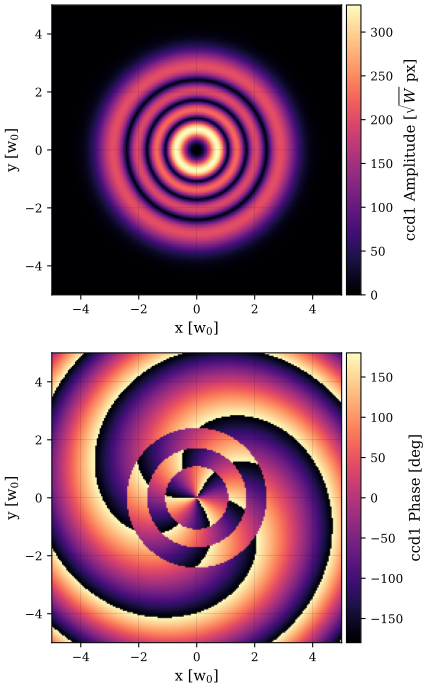
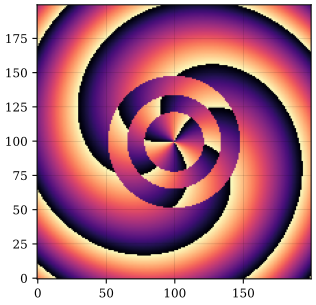
Finesse uses the Hermite–Gauss modes as a base system for describing the spatial properties of laser beams. However, Laguerre–Gauss modes can be created using the coefficients given in Eq. (9.43). This example demonstrates this and the use of a field camera fcam to plot amplitude and phase of a beam cross section (Fig. 97, generated here).
import finesse
finesse.init_plotting()

base = finesse.Model()
base.parse(
    """
    l l1                            # laser with P=1W at the default frequency
    gauss g1 l1.p1.o w0=1m z=0      # set up gaussian beam
    modes(maxtem=9)                 # include modes up to n+m=9
    tem(l1, 0, 0, 0, 0)             # HG coefficients to create LG33 mode
    tem(l1, 9, 0, 0.164063, 0)
    tem(l1, 8, 1, 0.164063, -90)
    tem(l1, 7, 2, 0, 0)
    tem(l1, 6, 3, 0.125, -90)
    tem(l1, 5, 4, 0.046875, 180)
    tem(l1, 4, 5, 0.046875, -90)
    tem(l1, 3, 6, 0.125, 180)
    tem(l1, 2, 7, 0, 0)
    tem(l1, 1, 8, 0.164063, 180)
    tem(l1, 0, 9, 0.164063, 90)

    s s1 l1.p1 nothing1.p1 L=1      # a space of 1m length
    nothing nothing1                # a nothing element to connect the detector
    fcam ccd1 nothing1.p1.i xlim=5 ylim=5 npts=200  # ccd camera at end of space
    """
)

out = base.run()
out.plot(figsize_scale=2);

import numpy as np
import matplotlib.pyplot as plt
plt.imshow(np.degrees(np.angle(out['ccd1'])));